Your Portfolio Matters More Than Ever
How Thoughtful Selection Shapes Stronger Submissions
So you want to apply for an open call, grant, residency, or competition, but you’re not sure where to start.
Start with your portfolio.
There’s a moment most artists reach (usually right before a submission deadline) when everything they’ve made starts to blur together.
You’re scrolling through photos. Opening old files. Revisiting pieces you haven’t looked at in months, sometimes years. And somewhere in that process, a question surfaces:
What actually belongs here?
Not everything you’ve made. Not everything you like. Not even everything that’s “good.”
Just the work that makes sense together.
In today’s art world, your portfolio isn’t just a collection of images. It’s often the first, and sometimes only, way your work is experienced. Whether you’re applying to exhibitions, open calls, residencies, or competitions, your portfolio does more than show what you make. It reveals how you think and work. And increasingly, that’s what sets artists apart.
The Shift from Making to Selecting
Most artists are trained to focus on production: developing ideas, experimenting, and finishing work. But very few are taught how to select.
Choosing what to include (and what to leave out) is a distinct creative skill. It requires distance, honesty, and restraint. Strong portfolios don’t feel comprehensive; they feel intentional. They show a clear line of thinking and a sense of direction. This is where many submissions fall apart. Not because the work isn’t strong, but because the selection isn’t focused.
A Brief Look Back: Who Controlled the Work?
Historically, artists rarely had the final word on how their work met the world. In 19th-century Paris, the official Salon exhibitions were chaotic, floor-to-ceiling marathons. Paintings were stacked tightly together, often based on size rather than subject, forcing artists to compete for oxygen in a crowded room. Placement was everything, and the artist had zero say in it.
The shift toward the modern portfolio began with two landmark acts of curatorial defiance:
1855: Courbet’s Pavilion of Realism
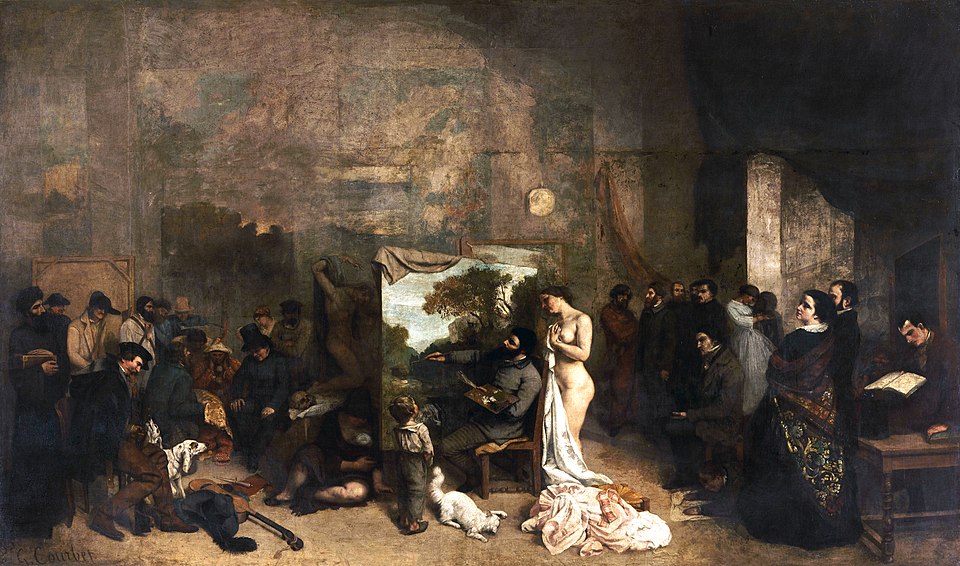
When the official jury of the Exposition Universelle rejected Gustave Courbet’s massive masterpiece, The Painter’s Studio, he refused to revise, resubmit, or soften his vision to fit the establishment.
Instead, Courbet created his own exhibition space, the Pavilion of Realism, just outside the official fairgrounds. There, he presented around forty of his paintings on his own terms.
This wasn’t just a bold gesture. It was one of the first truly independent exhibitions in modern art. Courbet controlled not only which works were shown, but how they were experienced: what was included, how the paintings were grouped, and what narrative they created together. In doing so, he challenged institutional authority and set a precedent that artists still follow today.
1905: Stieglitz and 291
A few decades later, Alfred Stieglitz brought this same level of intention into the world of photography.
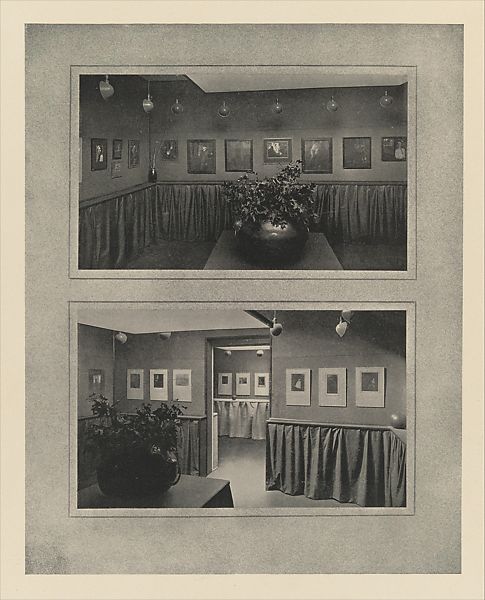
In 1905, he founded Gallery 291 in New York City. At a time when photography was still fighting for recognition as a fine art, Stieglitz treated the gallery walls like a composition.
291 became one of the first venues to introduce American audiences to European avant-garde artists such as Henri Matisse, Paul Cézanne, and Pablo Picasso, while also exhibiting American photographers and modernists alongside them.
What made 291 groundbreaking wasn’t just who was shown, but how the work was presented. Stieglitz paid meticulous attention to sequencing, spacing, and the relationships between pieces. Exhibitions were deliberately composed; images and artworks placed in conversation with one another, creating a cohesive viewing experience rather than a scattered display.
In doing so, he reinforced a now-familiar idea:
Presentation is not separate from the work. It shapes how the work is understood.
Your Digital Pavilion
Today, that responsibility has shifted entirely to you.
Your portfolio is your Pavilion. You aren’t just uploading files. You are controlling the walls, the lighting, and the sequence of the viewer’s experience.
The question is no longer:
Can you make good work?
The question is:
Can you present your work with clarity and intention?
Archive vs. Portfolio: Know the Difference
One of the most common mistakes artists make is treating their portfolio like an archive.
Uploading everything. Including every variation. Trying to show range at the expense of clarity.
But a portfolio is not a record of everything you’ve made. It’s a selection designed to communicate something specific.
Think of it this way:
An archive preserves.
A portfolio presents.
The difference is intention.
A strong portfolio doesn’t ask the viewer to figure things out. It guides them. It creates cohesion, even if the work explores different themes, materials, or ideas.
It doesn’t need to show everything. It needs to show what matters.
The Archive (Avoid This) vs. The Portfolio (Do This)
| The Archive (Avoid This) | The Portfolio (Do This) |
| Quantity: 40+ images to “show range.” | Focus: 10–15 images that “show depth.” |
| Goal: A historical record of your output. | Goal: A persuasive argument for your vision. |
| Experience: Navigating a warehouse. | Experience: A curated gallery tour. |
The red flag: If a juror sees three different styles or mediums in a ten-image submission, they don’t always see “versatility.” Often, they see an artist who hasn’t committed to a direction.
What Jurors Are Actually Looking For
When someone reviews your submission, they’re not just evaluating individual pieces. They’re asking:
- Does this work feel cohesive?
- Is there a clear direction or line of inquiry?
- Does the selection feel intentional?
- Can I understand how this artist thinks?
Jurors often see hundreds, sometimes thousands, of submissions. They’re moving quickly, but they’re also looking for signals of seriousness. A cohesive portfolio does that quietly. It shows that you’ve taken the time to shape your work, not just produce it.
Editing Is Part of the Practice
Editing your portfolio isn’t separate from your creative work; it’s an extension of it.
It asks different questions:
- Which pieces still feel aligned with what I’m exploring now?
- Where does the work feel strongest?
- Are there pieces that weaken the overall direction, even if they’re good on their own?
This is where it gets difficult.
Sometimes the strongest decision is removing a piece you love because it doesn’t belong in this group. That doesn’t diminish the work. It just means it belongs somewhere else; another series, another submission, another moment. Good editing creates clarity. And clarity builds trust.
🎨 RELATED READING: Why Artists Have Always Kept Notes (and Why You Should Too)
Digital Space Changes How Work Is Seen
Most portfolios today are viewed on screens, which means your work is often seen quickly, and often at a small scale. Because of this, sequencing matters more than ever.
The order of your images shapes how your work is understood. The first few pieces carry weight. They set expectations. They establish tone.
Ask yourself:
- Does the opening image represent the strength of the work?
- Does the sequence build naturally?
- Does anything feel out of place or abrupt?
Remember: you’re not just publishing images. You’re creating an experience.
Building a Digital Portfolio (and Why It Still Matters)
Social media has become an important part of how artists share their work. It’s immediate, accessible, and can open doors to new audiences and opportunities. But it’s not the same as a portfolio.
Social platforms are fast-moving. Work appears, gets seen briefly, and disappears into a feed. They’re designed for visibility…not for depth, context, or careful viewing.
Your website, on the other hand, is where your work lives with intention.
It’s where:
- Your strongest work is curated
- Your projects are grouped thoughtfully
- Your images are sequenced deliberately
- Your artist statement provides context
- Your practice is presented as a whole
If you don’t have a digital portfolio yet, start simple.
You don’t need something complex or highly designed. A clean, easy-to-navigate site is more effective than an overly complicated one.
Focus on:
- A clear homepage
- A small number of strong projects or series
- High-quality images
- Consistent formatting
- An updated artist statement
- Basic contact information
That’s enough.
Think of your website as your stable space, something you control. Unlike social media, it doesn’t shift with algorithms or trends. It allows your work to be experienced on your terms.
Social media can bring people to your work. Your portfolio is where they stay with it.
Cohesion Doesn’t Mean Sameness
A common misconception is that a strong portfolio needs to look uniform.
It doesn’t.
Cohesion comes from:
- Shared themes
- Consistent questions
- Material relationships
- Conceptual focus
Your work can evolve within a portfolio, but it should still feel like it belongs to the same conversation.
This is where your previous work on series becomes especially relevant. Submitting a body of work, even a loosely defined one, often creates a stronger impression than submitting unrelated pieces.
A Simple Framework for Building Your Portfolio
If you’re not sure where to start, try this:
1. Start broad
Gather more work than you need.
2. Narrow it down
Remove anything that feels off-topic, unresolved, or inconsistent.
3. Look for connections
What ideas or visual elements repeat?
4. Refine the group
Aim for clarity over quantity.
5. Sequence intentionally
Think about how the work unfolds.
This process takes time. It’s not something you rush the night before a deadline.
Bringing It Back to Submissions
When it’s time to apply—to an exhibition, open call, or competition—your portfolio is doing a lot of work for you.
It’s:
- Representing your practice
- Framing your ideas
- Supporting your artist statement
- Shaping first impressions
A thoughtful portfolio makes everything else stronger. It allows your work to be seen clearly, without distraction.
🎨 RELATED READING: How to Write an Artist Statement That Stands Out
Moving Forward with Intention
It’s easy to feel pressure to show everything. To prove range. To demonstrate productivity.
But strong portfolios aren’t built on volume. They’re built on clarity.
The artists who stand out are often the ones who make deliberate choices, not just in what they create, but in what they show.
Ready to Share Your Work?
When your portfolio reflects your thinking as clearly as your making, you’re in a strong position to apply, submit, and grow your visibility.
At TheArtList, artists and photographers can:
- Join our mailing list for curated open calls and exhibition opportunities delivered directly to your inbox
- Search for open calls that align with your practice and goals
- Enter the Artist of the Month Contest to gain recognition and expand your audience
Because your portfolio isn’t just a requirement, it’s a reflection of your practice. And the more intentional it is, the more clearly and confidently your work can be understood.