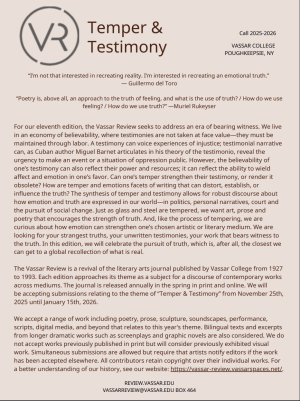
For our eleventh edition, the Vassar Review seeks to address an era of bearing witness. We live in an economy of believability, where testimonies are not taken at face value—they must be maintained through labor. A testimony can voice experiences of injustice; testimonial narrative can, as Cuban author Miguel Barnet articulates in his theory of the testimonio, reveal the urgency to make an event or a situation of oppression public. However, the believability of one’s testimony can also reflect their power and resources; it can reflect the ability to wield affect and emotion in one’s favor. Can one’s temper strengthen their testimony, or render it obsolete? How are temper and emotions facets of writing that can distort, establish, or influence the truth? The synthesis of temper and testimony allows for robust discourse about how emotion and truth are expressed in our world—in politics, personal narratives, court and the pursuit of social change. Just as glass and steel are tempered, we want art, prose and poetry that encourages the strength of truth. And, like the process of tempering, we are curious about how emotion can strengthen one’s chosen artistic or literary medium. We are looking for your strangest truths, your unwritten testimonies, your work that bears witness to the truth. In this edition, we will celebrate the pursuit of truth, which is, after all, the closest we can get to a global recollection of what is real. The Vassar Review is a revival of the literary...